


Field Notes
Field Notes from Asmat: Between River, Rain and Carved Memory
Pacébo · 28 June 2026
Some places are remembered through landmarks. Asmat is remembered through water, wood, voices, and the feeling of moving slowly into another world.
The first thing we notice in Asmat is not the distance.
It is the water.
Water beneath the houses. Water beside the walkways. Water carrying boats between villages. Water rising and falling with the tides, shaping the rhythm of everyday life.
In Agats, the administrative center of Asmat, the relationship between land and water feels different from almost anywhere else in Indonesia.
There are no ordinary streets in the way most travelers understand them.
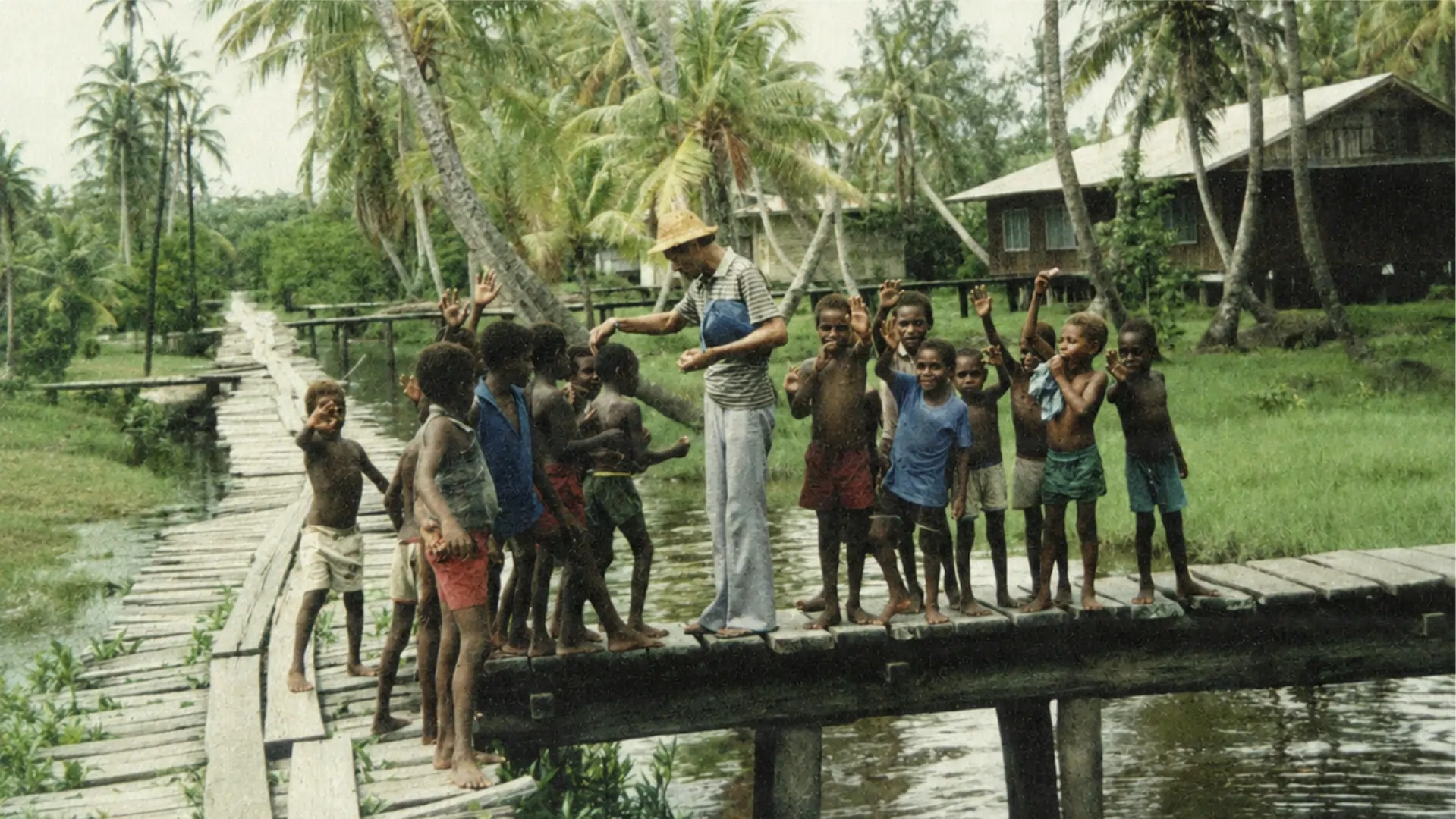
Much of the town stands above swampy ground, connected by raised wooden and concrete walkways. Motorcycles pass over the boardwalks. Children walk to school. Goods arrive from boats at the riverfront. Small shops open beside houses built above the mud.
Everything seems to have adapted to the landscape rather than attempting to dominate it.
For a visitor arriving for the first time, it takes a moment to adjust.
Then the rhythm begins to make sense.
This is our field note from Asmat.
Not an attempt to explain an entire culture.
Simply observations from a place where rivers remain roads, wood carries memory, and travel still requires time.
Morning in Agats
Morning begins early.
The air is already humid.
The riverfront slowly becomes active as boats arrive and depart. People carry boxes, fuel, vegetables, sacks of rice, drinking water, building materials, and whatever else is needed in a town that depends heavily on river transportation.
There is movement everywhere, but it does not feel hurried.
Agats has its own pace.
From the boardwalks, the town appears almost suspended between river and swamp.
A motorcycle approaches from behind.
Its tires create a familiar vibration against the walkway before it passes.
A few meters away, someone is repairing a boat.
Children in school uniforms walk past.
From another direction comes the sound of a church bell.
Then the rain begins.
Not dramatic.
Just another part of the day.
People continue moving.
In Asmat, weather is not an interruption to life.
It is part of life.
The River Is the Road
To understand Asmat, sooner or later we have to leave the walkways behind.
We board a boat.
The engine starts, and Agats begins to disappear behind us.
Ahead are rivers, tributaries, mangroves, mudbanks, and long stretches of green.
There are no road signs.
No asphalt.
No traffic lights.
Only water.
The further we travel, the more clearly we understand something that looks obvious on a map but feels completely different in reality:
In Asmat, the river is not simply part of the landscape.
The river is infrastructure.
It connects families.
It connects villages.
It carries food.
It carries children to school.
It carries timber, sago, fuel, visitors, government officials, priests, traders, teachers, and stories.
What appears remote to us is connected through another geography.
A geography of water.
Occasionally another canoe or motorboat passes.
A hand is raised.
A greeting is exchanged.
Then the boat disappears behind a bend in the river.
The forest closes again.
What the Map Does Not Show
On a map, two places may appear close together.
On the river, distance feels different.
Travel depends on the boat, the tide, the weather, the water level, the current, the fuel, and local knowledge.
A journey that looks straightforward can take hours.
This is one of the first lessons Asmat gives the traveler:
Distance here cannot always be measured in kilometers.
It is measured in time, conditions, patience, and experience.
This is also why travel in Asmat should never be rushed.
Trying to reduce the destination into a checklist misses the point.
Village.
Photograph.
Carving.
Boat.
Return.
Asmat deserves more than that.
The journey between places is part of understanding the place itself.
Sometimes nothing appears to happen for a long time.
And yet those are often the moments we remember most.
The sound of the engine.
Rain moving across the river.
Mangrove roots appearing at low tide.
A fisherman standing in a narrow canoe.
Smoke rising somewhere beyond the trees.
A child waving from a riverbank.
These small observations rarely appear in an itinerary.
But they become part of the journey.
Entering a Village
Arriving in a village is different from arriving at a tourist attraction.
There is no entrance gate separating visitors from everyday life.
We are entering someone's home.
People are working.
Children are playing.
Someone may be preparing food.
Someone may be repairing a canoe.
Someone may simply be sitting and talking.
The first responsibility is therefore not to photograph.
It is to arrive properly.
To greet.
To listen.
To understand who is welcoming us.
To allow the local guide or community contact to establish the relationship before cameras appear.
This sounds simple.
But it changes the character of an encounter.
Travel becomes less about collecting images and more about being present.
In a remote cultural destination, access should never be confused with entitlement.
Being able to enter a community does not mean everything is ours to photograph, interpret, or consume.
Sometimes the most respectful thing a traveler can do is simply observe.
Wood Everywhere
Wood is everywhere in Asmat.
In houses.
In walkways.
In canoes.
In paddles.
In tools.
And, of course, in carving.
But seeing Asmat carving in its own environment feels very different from seeing it displayed far away in a museum or gallery.
Here, wood does not begin as art.
It begins in the forest.
A tree becomes material.
Material becomes an object.
And an object may carry function, identity, memory, ancestry, or ceremony.
This is where the distinction between handicraft and cultural expression becomes important.
To an unfamiliar visitor, a carved shield may first appear as an extraordinary work of art.
And it is.
But beauty is only one layer.
Behind the form may be family history, ancestral reference, clan identity, personal memory, spiritual meaning, or cultural knowledge passed from one generation to another.
The carving cannot be fully understood by looking only at its surface.
Watching a Carver
There is something different about watching an object slowly emerge from wood.
The process is physical.
Measured.
Repetitive.
Hands follow forms that have been learned over years.
A younger generation may work differently from their fathers or grandfathers. Tools change. Markets change. Outside influences enter. Designs may evolve.
Culture is never completely frozen.
But beneath those changes remains something more important:
Knowledge is still passing through hands.
This may be one of the most powerful things about Asmat carving.
It is not simply that old objects survive.
It is that the ability to create meaning through wood continues.
A museum can preserve an object.
A living tradition preserves the knowledge required to make another one.
Before the Villages, Visit the Museum
For travelers arriving in Agats, the Asmat Museum of Culture and Progress deserves more than a quick visit.
We think of it as preparation.
A place to slow down before traveling deeper.
Inside are objects that help introduce the visual language of Asmat culture: shields, drums, paddles, ancestor figures, ceremonial carvings, and other forms created for different purposes and contexts.
Without background knowledge, a visitor may simply see an impressive collection.
With time, the objects begin to ask questions.
Who made this?
For whom?
What did the symbols mean?
Was it ceremonial?
Was it connected to an ancestor?
Was it used in daily life?
Does the same tradition still exist today?
A good museum does not make a culture simpler.
It makes us realize how much we still do not understand.
That is valuable.
Because curiosity accompanied by humility is a better starting point for cultural travel than certainty.
The Many Worlds of Agats
Agats also reminds us that remote places are rarely as isolated as outsiders imagine.
The town is Asmat, but it is also part of modern Indonesia.
Churches stand within the community.
Government offices operate above the swamp.
Schools connect younger generations with national education.
Mobile phones and internet access have changed communication.
Goods arrive from other islands.
Traders and migrants from different parts of Indonesia live alongside local communities.
Among them are Bugis traders from Sulawesi, continuing a much older pattern of maritime movement and commerce throughout eastern Indonesia.
For us, coming from Sulawesi, encountering Bugis communities this far east is strangely familiar.
Names.
Accents.
Food.
Small conversations.
Fragments of home appearing thousands of kilometers away.
Indonesia has always been connected by movement.
People travel.
People trade.
People marry.
People settle.
Communities change.
Agats is therefore not a place suspended outside time.
It is a place negotiating many layers at once: Asmat identity, Christianity, government, commerce, education, migration, technology, and ancestral tradition.
The interesting question is not whether Asmat has changed.
Every culture changes.
The more important question is what continues despite that change.
Sago, Forest and Everyday Knowledge
Not every cultural lesson comes from ceremonies.
Sometimes it comes from food.
Sago remains deeply connected to life in many parts of Papua, including Asmat.
To an outsider, sago may simply appear as something served on a plate.
But following the process backward leads us into another understanding of the landscape.
The palm.
The forest.
The labor.
The processing.
The sharing.
The knowledge of where to find resources and how to use them.
Food reveals ecology.
Ecology reveals culture.
Culture reveals relationships.
This is another reason why traveling slowly matters.
A traveler searching only for dramatic moments may overlook the knowledge hidden inside ordinary activities.
But everyday life is often where culture is most visible.
The Camera Problem
Asmat is visually powerful.
The rivers.
The faces.
The carvings.
The boats.
The houses.
The forest.
It is easy to arrive thinking like a photographer.
We understand the temptation.
But the camera can also create distance.
A person becomes a subject.
A house becomes a composition.
A ceremony becomes content.
A community becomes something observed rather than encountered.
There is nothing wrong with photography.
But the order matters.
Meet first.
Photograph second.
Ask when appropriate.
Understand when not to photograph.
And sometimes leave the camera inside the bag.
Not every memory needs evidence.
Rain Changes the Plan
There is a particular kind of travel expectation that does not survive long in places like Asmat.
The expectation that everything will happen exactly on schedule.
Rain comes.
A boat is delayed.
The river changes.
Someone we expected to meet is somewhere else.
Village activities take priority over visitors.
Plans move.
This is not necessarily bad organization.
It is often simply the reality of traveling through an environment where nature and local life remain stronger than the itinerary.
The solution is not to eliminate uncertainty.
The solution is to travel with enough flexibility to absorb it.
This is especially important in remote Indonesia.
An itinerary should provide structure.
It should not create the illusion that a living place operates according to our timetable.
What Remoteness Really Means
The word remote is used constantly in travel.
Remote resort.
Remote island.
Remote village.
Remote expedition.
Sometimes it becomes little more than marketing language.
Asmat reminds us that remoteness has practical meaning.
It can mean limited transportation.
Expensive logistics.
Unpredictable weather.
Basic accommodation.
Few alternatives when something changes.
Long distances to medical facilities.
Dependence on people who genuinely understand the local environment.
Remoteness can be beautiful.
But it should never be romanticized so much that its realities disappear.
Responsible expedition travel begins by respecting those realities.
The Things We Carry Back
When leaving Asmat, it is easy to remember the largest things.
The great rivers.
The forest.
The carvings.
The distance.
But field notes are often made from smaller memories.
Wet shoes beside a doorway.
The vibration of motorcycles crossing the boardwalk in Agats.
A boatman reading the river without ever looking at a map.
Wood shavings falling from a carving.
Children laughing when visitors attempt unfamiliar words.
A sudden rainstorm.
Coffee shared while waiting.
The quiet after the boat engine stops.
These details are difficult to place inside a brochure.
Yet they are often the reason a journey remains with us.
A Note to Future Travelers
Come to Asmat with curiosity.
But leave certainty behind.
Do not expect every question to have an immediate answer.
Do not expect every tradition to be explained.
Do not expect ceremonies to exist for your schedule.
Do not expect remoteness to provide comfort.
And do not mistake simplicity of infrastructure for simplicity of culture.
Listen to local guides.
Give people time.
Ask before photographing.
Accept changes.
Visit the museum.
Watch the river.
Notice everyday life.
And remember that you are entering a world that existed long before you arrived and will continue after you leave.
The privilege of travel is not simply that we are allowed to see another place.
It is that, for a brief moment, we are allowed to enter another way of understanding the world.
Asmat stays with us for that reason.
Not because it is distant.
Not because it is exotic.
But because beneath the rain, rivers, mangroves, walkways, canoes, and carved wood, there is a profound sense of continuity.
People remembering through objects.
Knowledge passing through hands.
Families moving along rivers travelled for generations.
A culture changing, adapting, and continuing.
These are only field notes.
Fragments from the river.
Observations from the mangrove world.
But perhaps that is the right way to write about Asmat.
Not as if we have understood everything.
Only as travelers who arrived, listened, learned something—
and left with more questions than when we came.
Field Notes from Asmat
The river carries people.
The forest provides.
The hands remember.